May 25, 2011


May 19, 2011

May 15, 2011


April 26, 2011
The GWEN TEN*
* or, things I have learned from my voice teacher over the past few years.
- I am thy teacher who brought thee to the stage. Thou shalt have no other directors, critics, advisors before me.
- Honor thy microphone and keep thy mouth four inches from it.
- Flap not thy lyric sheet, but hold it still by thy side.
- Remember the bright lights, thou womenfolk, and keep thy face to shine with makeup.
- Sing not directly to thy loved ones, nor make eye contact with them.
- Dwell near each other, thou duet partners, lest there be a great expanse between ye on the video.
- Thou shalt not wear hats, boas, maribou, nor any rainment of poultry in the Cabaret.
- Thou shalt not make any introduction, nor make apology prior to singing.
- Thou shalt not look upon thy accompanist, nor shall ye call attention to any error made thereon.
- Thou shalt not wear white nor pastel colors
for these things are an abomination to me.
April 24, 2011
Careers
All of us parents of special needs high school juniors and seniors are in a cold sweat. What are our kids going to do post-high school? I am ahead of the game since I can see Hart's and Jeff's strengths so clearly. My prediction for future careers:
Jeff, grifter. Jeff shows amazing aptitude for the confidence game. He is a genius at elaborate cons, involving his parents, caregivers, teachers and classmates. Although I am chagrined at this, I do have to marvel at the skill involved.
Hart, neighborhood crazy person. I recently told Hart's social worker that even I am creeped out by the strange gait, bizarre outbursts and non-sequiters mid-conversation, and constant muttering. Every community has a strange, harmless resident. I suspect I know who that will be.
April 20, 2011
William S Shore, 1921-2011
In the famous line from the 1967 movie "The Graduate", the character Mr. Maguire says to the young protagonist Ben - "I have just one word for you Ben - Plastics". Nearly 20 years before that, a brilliant young chemistry and medical student, William S Shore, at The Charles University in Prague was dreaming up ways to synthesize new chemical compounds, especially hormones, plastics and polymers, that would propel mankind into a new future of technological and medical achievement. William Shore turned those dreams into reality as the principal plastics engineer in the development of the Chevrolet Corvette body. In addition, he was one of the principal developers of the Clorox plastic bottle (1959) and the blow molding process by which it and the plastic milk bottle (1964) was created. In his later years, Shore's environmental concerns led him to create Home Environmental Products, a corporation devoted to lessening water waste and pesticide use in agricultural settings. A brilliant polymath and Renaissance man (Shore's family and friends refer to him as the Google search engine before Google existed - ask him any obscure fact and he would know it) Shore was also a world-renowned cosmologist andastrophysicist. Shore died of natural causes in Chatsworth California at 90 years of age on Friday, April 15, 2011.
Shore was the eldest of four sons, born into a Jewish family on February 26, 1921 in Czechoslovakia. After completing his undergraduate work in chemistry and physics Shore was taken to his first concentration camp in 1942 as a Jewish prisoner. Virtually all of the other Jews brought into this work camp died in the minefields, having been forced to walk in front of the advancing German fronts. Shore would always express his optimism as it was his destiny "to be at the right place at the right time". Shore had sustained a right hip injury that gave him a limp. The sergeant in charge of sending the young men out to walk long distances in front of the Army did not believe Shore could make the walk and kept him back at the camp to work there. Shore, and the rest of his family, was taken by train in the middle of the night to the Auschwitz concentration camp. His parents and one of the brothers and hundreds of relatives and friends perished in the camps. Shore survived the Holocaust, including the Auschwitz-Birkenau and Crakow-Plaszow (made famous in Schindler's List) concentration camps. Shore was then faced with a new threat when the Communists took over Czechoslovakia in 1948. Just before completing his doctorate, his visa to immigrate to the United States came through and took advantage of it making his way to Cleveland, Ohio.
The DuPont Corporation's famous advertising slogan" Better Things for Better Living . . .Through Chemistry" were his watchwords. His initial interest was in medical pharmaceuticals, specifically the development of synthetic steroids. In 1950 he worked on a process of synthesizing various 17 keto steroids at the Case Western Reserve School of Medicine. However, he made a decision to focus his chemical engineering brilliance on synthetic polymers useful in the industrial setting--specifically, plastics. He knew that theoretically polymers could be used for practically any purpose - from the early computer motherboards to automotive parts. He quickly became an expert in the following modification of plastic polymers to achieve very precise specifications required for industrial applications. In 1951, he
was hired as the director of research and development at the Dynakon Corporation in Cleveland Ohio. There, he perfected the art of creating plastic resins, specifically polyester,vinyl ester, and epoxies for use in fiberglass reinforced plastics.
Shore and Dynakon were at the right place at the right time in Cleveland Ohio, one of the major manufacturing centers in the United States in the post - World War II era. Its proximity to the big three Detroit automobile headquarters made it a natural for the subcontracting of automobile parts manufacturing. This became fortuitous for several Cleveland-based companies when General Motors saw the tremendous response to the original Corvette concept car at the New York auto show and decided to put it into production. Originally conceived in steel body, it was then decided at the last minute to produce the body panels in fiberglass reinforced plastics. This was done principally to save startup costs and provide the added benefits of a new technology and reduced weight.
In February, of 1953, Robert Morrison of the Molded Fiberglass Company in Cleveland received a $4 million contract for producing the 1953 and 1954 Corvette body panels. Morrison and company already had considerable experience in the production of fiberglass reinforced plastics but they were under significant pressure to achieve specifications necessary for automotive body panels that they had not previously produced. Morrison subcontracted with William Shore and his team at Dynakon to perfect the plastic resin. Initially there were many problems with the precise percentages of the Isothallic plastic resin, inert ammonium silicate, and fiberglass fibers. Eventually, Shore's engineering team developed the perfect resin blend. The final percentage was 41% plastic, 30% fiberglass and 29% inert silicate. The body panels were tested by GM engineers and found that they met all of their specifications.
On June 29, 1953 the first ofthe initial 300-1953 model Chevrolet Corvettes rolled off the assembly line. It was the first series production automobile made with a "fiberglass" body. Shore would always jokingly object to the designation of "fiberglass" body. He would say "after all it's 41% plastic and only 30% fiberglass". He much preferred another term of endearment for the Corvette body: "the plastic fantastic". To honor his work, Shore was offered one of the first 300 Corvettes at General Motor's invoice cost. His answer was "what am I going to do with the car with no backseat and a small trunk". When he found out that one of the early serial number 1953 Corvettes had sold recently for $1 million Shore said, "Like so many things in life, if only we knew then what we know now"! Shore had virtually no interest in automobiles - his focus was purely on the polymer material technology. Soon thereafter, Shore developed the plastic compounds for melamine dinnerware, structural building materials, plastic protective automobile side moldings, and many new applications used by the United States military.
In 1959, again at the right place at the right time, Shore was working on the development of highdensity polyethylene plastics. He realized that this material was far safer, lighter, and less expensive than glass or metal alternatives as containers for various liquids including milk or bleaches. Clorox .Corporation, the largest manufacturer of bleach in the United States, contracted with Shore to be one of their early producers of blow molded high-density polyethylene white Clorox bottles. Shore also helped to perfect the blow molding process for these applications. Five years later in 1964, these blow molded plastic bottles began to replace the glass milk bottle.
After a trip to Israel in 1981, William Shore's life was transformed. In this small country with no significant natural resources and little water supply, Shore saw the need to save water. A master photographer, Shore's prize-winning photographs were almost universally taken in nature. He published a book "Expressions of Nature Through Photography and Words", a compilation of his life's photographic work. His love of nature and the environment spurred his interest in the recyclability of plastic products as well as their potential for saving what he saw as the most precious product necessary for mankind: water, using plastics. He patented a production system for the use of plastic film of precise rigidity, flexibility, and porosity for the growing and storing of agricultural products. Fundamentally, his "plant packaging system" was a scalable combination of a greenhouse and terrarium that would preserve the water content and recycle it. In addition, it was a natural barrier to insects that would eliminate the need for pesticides and all of their environmental consequences.
Shore was a polymath and Renaissance man with a nearly perfect photographic memory. An incessant reader he became so expert in astrophysics and cosmology that he was elected president of the Cleveland Astronomical Society during the 1980s. Again, being at the right place at the right time was important for William Shore. In 1987, he worked tirelessly along with Case Western Reserve University personnel to create one of the most famous meetings of world prominent physicists: the 1987 Centennial Anniversary of the Michelson Morley Experiment. In 1887, the Michelson Morley experiment on the splitting of light was critical information for all the new physics, including Einstein's theories of relativity. This experiment performed by the Case Western Reserve University scientists has been called the "beginning of the second scientific revolution". Many Nobel prize winners attended the meeting including Murray Gell-Mann, Ph.D. Shore and Gell Mann discussed their mutual belief in string theory at these meetings and subsequently.
William Shore spent his final years studying writing and lecturing on his wide variety of interests. Of particular interest near the end of his life was proving that the biblical Genesis story and the Big Bang cosmological theory were expressions of the same reality and completely consistent. He famously said "if God wrote the Bible, he couldn't express it in terms of 20th century physics to people living thousands of years ago."
William Shore is survived by his first wife Carol Wilson Hudson and his second wife Erica Stux- Shore, two sons; Philip S. Shore, M.D. (wife Diana), and Robert M. Shore (wife Julie), and two grandchildren Adam Shore and Allison Shore.
April 17, 2011


April 5, 2011
Caribbean Cruise, March 2011 (slideshow)
Click the title to see photos!
For the past two years, during Jeff's spring break, he and I have gone to Europe. These trips, while not elaborate or luxe, are masterpieces of research, planning and organizing. I know that Jeff would not want to "wing it" and he doesn't care for unstructured meandering. I found out in London that Jeff won't tolerate impromptu consultation with a map or guidebook either. So around January this year, I pored over the Internet to work out a trip to Belgium and the Netherlands.
But it was not to be. Jeff went off the rails for most of February and a European trip just seemed too daunting. I assumed we would spend spring break here, with Jeff playing with his cars and complaining of boredom, and me, pouting.
For the past two years, during Jeff's spring break, he and I have gone to Europe. These trips, while not elaborate or luxe, are masterpieces of research, planning and organizing. I know that Jeff would not want to "wing it" and he doesn't care for unstructured meandering. I found out in London that Jeff won't tolerate impromptu consultation with a map or guidebook either. So around January this year, I pored over the Internet to work out a trip to Belgium and the Netherlands.
But it was not to be. Jeff went off the rails for most of February and a European trip just seemed too daunting. I assumed we would spend spring break here, with Jeff playing with his cars and complaining of boredom, and me, pouting.
In February, I had an inspiration: a cruise! So my friend Meiya, Jeff and I headed to the Port of Miami for a week's cruise to Roatan, Honduras and Cozumel, Mexico on Celebrity Cruises' CENTURY. Meiya and I had a great time lounging, playing trivia games (best score ever on the Broadway musicals trivia contest), singing karaoke and eating. Jeff had a wonderful time, doing whatever it is he did aboard ship. We saw him for meals and occasionally he passed by us.
February 8, 2011
Life with Inky and Jeff
"It's cat duty time. I think she's on cat patrol.""Inky is taking a bath. She looks like a a chicken."
February 2, 2011
Prodigal Son
J: You know the nice Jeff is back. He was on a cruise.
L: I am so glad to have him back.
J: Since he was on a cruise he sent the obnoxious Jeff to take his place.
L: Well, welcome back! How was the cruise?
J: Nice and warm in the Bahamas.
L: I am so glad to have him back.
J: Since he was on a cruise he sent the obnoxious Jeff to take his place.
L: Well, welcome back! How was the cruise?
J: Nice and warm in the Bahamas.
January 11, 2011
Evanston Speed Skating Club news
 Every January for the past eighteen years, special needs skaters arrive from all over the Midwest for Franklin Park's Special Needs Skating Competition, to participate in one or more of four ice sports: hockey, figure skating, speed skating and sled hockey. This event is a precursor to the Illinois Winter Special Olympics which are held in Galena in February.
At this year's event on January 8, Jeff took first place in the H division, the tier of the fastest skaters. Special Needs skaters are grouped by ability rather than age. He won first place in all three distances; 333m, 500m, 700m.
Jeff is a long-time member of the Evanston Speed Skating Club, and ESSC's only special needs member. "Regular competitions all season with his age-mates have really motivated Jeff to work hard and improve his times," says ESSC coach George Babicz. "I'm proud of his win, but not surprised."
Jeff is currently a high school junior at The Cove School in Northbrook. Cove School serves students with moderate to severe learning disabilities. Jeff joined ESSC as a third grader: this is his ninth season skating.
"I initially thought of speed skating for Jeff because the demands of a team sport would have been very difficult, due to Jeff's disability," says his mother, Lydia. "I didn't know anything about speed skating. But the individual endeavor of the sport appealed to me."
Jeff also plays guitar and is on Cove's basketball team, but speed skating is his favorite activity. He has met Olympic medalist Shani Davis a number of times, often enough to have a running game of tag with Shani over the past six years. "The friends and experiences Jeff has had skating are wonderful, but annoying Shani is fun for him, too."
December 29, 2010
December 16, 2010
Heartbreaking evidence
 I spent this afternoon again in the depth of the archive of the Jewish community. I found there something not really pleasant.
Samuel Stux - married to Katharina Loeb - had 7 daughters & 1 son.
One of these daughters was Malvine and another one was Amalie (born 25 Oct 1869).
This Amalie was married to Sandor (Alexander) Braun and 1 daughter & 4 sons.
Daughter Emma (b. 1 Jan 1899) got married to Emil Philippovic. These 2 had a daughter called Ilse Ernestine, born 1929 and died already at the age of 12 years in 1941. (family book p 102.)
The archivist looked in his files and found a file where Ilse is buried and there is mentioned why she died: Bromalpneunomie bei Idiotie = pneumonia with idiocy.
And according to that file she died at Baumgartenhöhe which is know here as where the mentally sick people are treated. A 12-year old girl?
So the archivist searched in his computer and found more information which is provided by the documentation archive (DÖW) and there it says she was indeed in the part of Baumgartenhöhe called 'Spiegelgrund'.
This 'hospital' Spiegelgrund was the place where the Nazis 'fulfilled' their children euthanasia programme . . .
Spiegelgrund, Deutsch
G
December 14, 2010
November 20, 2010

November 13, 2010
Go, Jeff, go! (photo)
 ESSC Bulletin-16 November 2010
Having waves of genius, Jeff reacted spontaneously to the opportunity to win his second race. This is just not something coaches can teach. Jeffrey has been working at speedskating for a long time and has acquired a lot of experience. With confidence, Jeff continues to prove dominant, winning the remainder of his races. The crowd went crazy. Brilliant racing, Jeff!
November 7, 2010
Koala Lore
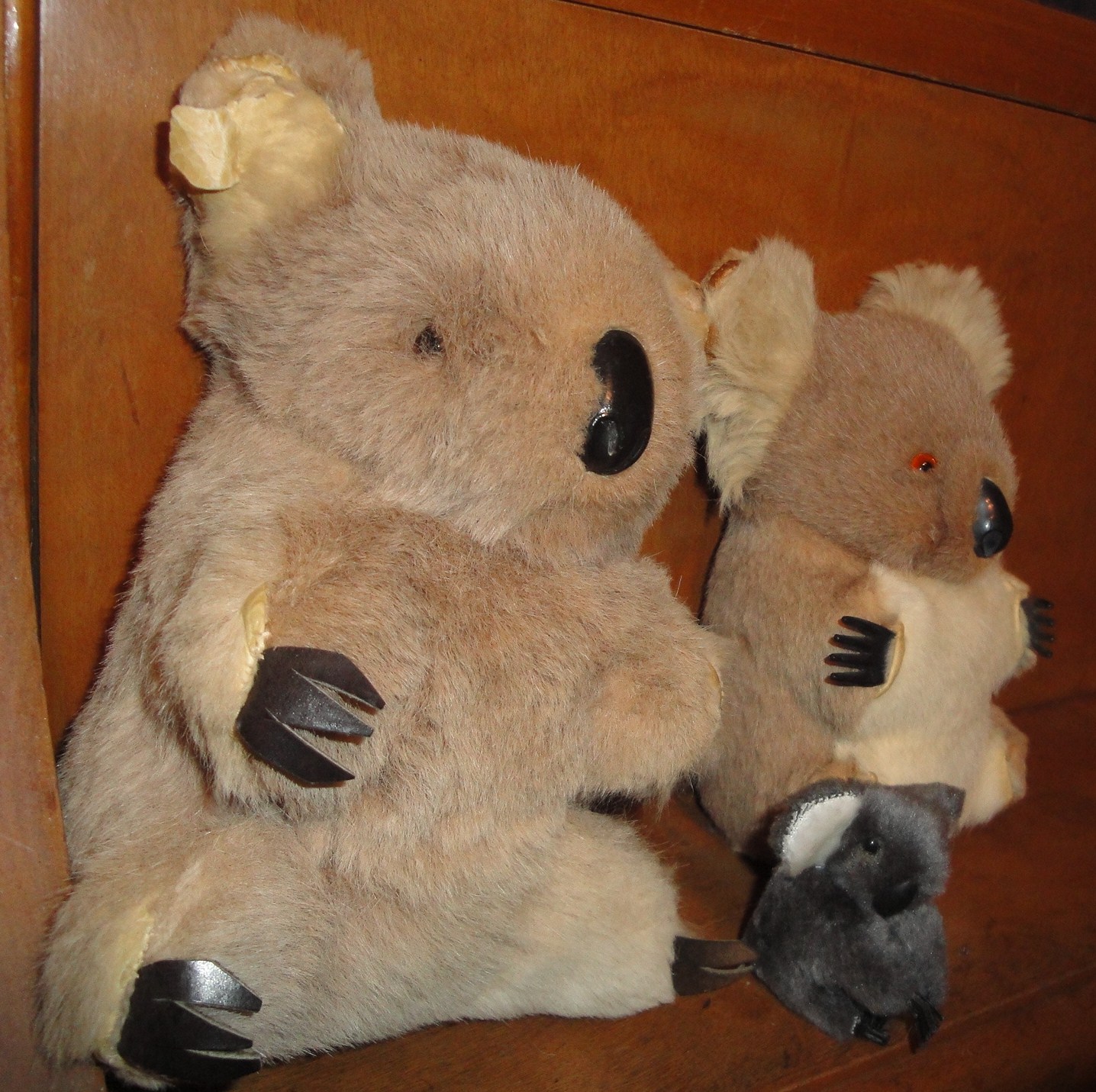
The big koala on the left is Two Thumbs. He was present on my first or second birthday from my cousins in Australia. Australian cousins--how exotic! Obviously, Two Thumbs has been with me a very long time. Two Thumbs was named after a koala character in a picture book, also a present from Australia.
A number of years ago, I found another koala at an estate sale. This smaller one appeared to be of the same material, design and vintage as Two Thumbs, so I bought him. Hart and Jeff dubbed him Two Thumbs' Little Brother. Shortly after that, Hart gave me the tiny koala, explaining that Little Brother should have a companion, too.
It's a charming story, a bit of family lore with chapters added by the succeeding generations. As family stories go, it's not quite as exciting as, "Grandpa's Escape from Auschwitz," or as amazing as, "My Two Brothers are YOUR Two Uncles." Stories of my childhood and my background aren't meant to displace the boys' lost lore. I don't know the background or stories of their birth family or native country. So I'm encouraging them to appropriate my narrative, and append their own chapters.
Maybe the koala collection is complete, but it's possible that there will be others added to it. Jeff and Hart can explain that it all began with Two Thumbs, the de facto patriarch of the koalas, and that other toy koalas joined him, each with their own history and narrative (just as the boys joined my family).
October 22, 2010

Subscribe to:
Posts (Atom)