May 31, 2007

School Daze

Hart's school career thus far has hardly been stellar, but now nearing the end of 7th grade, we are entering the home stretch, ready or not. Both Hart and Jeff started out in our local public school district, in the “pre-primary diagnostic room,” which is special educationese for “give these delayed kids a head start.” He continued at the same school in the special ed classroom for two years of kindergarten (August birthday), and two more years in the primary special ed classroom.

Nearing the end of 2nd grade, his sixth year of public education, his teacher took me aside and said earnestly, “I don’t know if we are doing Hart a favor, allowing him to limp along in this setting. I think he might do better in a more structured classroom of behavior and emotionally disordered kids.”


It was a nice theory. Hart washed out of third grade so spectacularly, the administrators all but threw a party when he was asked to leave. Off he went to a specialized private school.


While it has been a very nurturing and loving environment, which is just what Hart needed after the debacle of six weeks of public school psycho third grade, he hasn’t made much academic progress in his five years there. Sad to say, Hart just isn’t a very motivated learner. In fact, he is not much of a learner at all. I often wonder if around first grade, he had some revelation. “I know the alphabet and I can count. My work is done.”

Today we made an orientation visit to yet another school. This is the last stop for Hart. Next fall he will be there, a private school for developmentally disabled students. While I dare not set my expectations too high, I am reassured that the next few years are taken care of. Through eighth grade, the students share the building with a larger population of “regular” kids. Grades nine though twelve are at a Jewish high school in the city, one block from his current school. Then come vocational services, job placement and job supervision. I don’t expect Hart to make up for lost time, but at least I can see the trajectory of the next few years, and as is the watchword in special education, it looks APPROPRIATE.


May 30, 2007

Constitution Test review

L: Under the Constitution, can you be President?*
J: No.
L: Why not?
J: I am too young.

*I remember that the President had to be born in the U.S., but apparently, this is not true anymore.

May 24, 2007

An Old-Fashioned Girl

My elderly aunt still refers to Memorial Day as Decoration Day, and to the Museum of Science and Industry as "ze Rosenvald Museum," as if a member of the founding Rosenwald family might actually greet visitors at the entrance.

I don't say "filling station" and "five-and-dime," but I do catch myself saying, "record" and "album" when referring to music. The gesture I know for "dial a phone" is making a clockwise circle with a forefinger.


My Chicago references are archaic, dating from my arrival here in the early 80s. I know the "el" lines by their terminus stations, not by their colors. The Bishop-Ford Expressway, what's that? Marshall Field's had long ceased to "give the lady what she wants," but calling that building Macy's sounds foreign, if not pretentious.

I astonish the boys with tales of the "olden days," before cell phones, videos, email. We watched black and white TV. (No!) There were only three channels. (The horror!) If you were out and you needed to make a phone call, you had to find a pay phone booth. (Huh?)

A few years ago, I inherited my dad's 1947 portable Corona, a relic from college. I was eager to show it to Hart and Jeff.

Me: Can you guess what this is?
H & J: No.
Me: It belonged to Grandpa. It's an old typewriter.
H: What is it for?
Me: Before there were computers,
if you wanted to write a letter or a report, you used this.
H:
No games?

May 18, 2007

Extraterrestrials

I read an interview with noted animal behaviorist and autistic, Temple Grandin, where she described herself as feeling like "an anthropologist on Mars." A common theme in writings of autistic adults is the stress and anxiety they feel trying to fit in to "our world."

I understand and sympathize. I have spent too much time in Jeffworld and Hartworld not to. But that does not mean I like it there.

I prefer the "neurologically typical" world, where people make eye contact, speak to me in English words and sentences, and modulate their voices depending on the distance between themselves and the listener. In this world, some experiences are interesting and exciting, and some are boring or mundane.

I have no choice but to navigate in the boys' world--where life is loud, fast, daring, unpredictable and thrilling all the time. Social conventions are irrelevant. Impulsivity reigns supreme.

However--true confession here--the bizarre worlds of other impaired kids are just too much for me. I have tremendous appreciation and respect for adults who choose to work with these children: There isn't enough money in the world to pay me to do it.

Since both boys are in specialized private schools, I am frequently called upon for volunteer duties. Of course I participate, but that doesn't mean I like it.

I used to carpool another boy after school. Bright and gregarious, he had a sole passion in life: oceans. To communicate with him, you had to talk about oceanography, and if you didn't feel like it, it did not matter. He carried on a nonstop monologue for the entire ride. When it got too distracting, I would say, "Jason, stop talking now." After making a left turn or merging into highway traffic, I would say, "Go on," and he would pick up mid-sentence where he left off. Once, when all three boys were talking loudly at once, I bellowed, "Everyone, be quiet now!" A moment later, a voice piped up, "You can't stop me from talking about oceans." True enough, but that does not make it any less annoying.

At dinner with another family, their daughter told she me she was thinking of a song she knew, which she proceeded to sing throughout the entire meal, until her dad gently said, "Please sing in your head. I am having trouble hearing the conversation."

To the classmate who was screaming and jostling Jeff at a school function, I barked, "Our family rule is no touching other people. And if you can't use your inside voice, you can't sit with us!"

Although I am impatient, I understand, really I do, how difficult it is for these kids. I have two aliens of my own.

May 16, 2007

Passport

Since I have planned an exciting vacation this summer, Hart and I need passports. I dutifully appeared at our township clerk's office, laden with folders of documents.
As it happened, the passport clerk was training an apprentice, presumably for the summer passport rush. "Have at it," I said. "This one should be more complicated and unusual that most."

Dutifully, I produced:

A notarized affidavit from the absentee parent to permit to get Hart a passport.

Proof of citizenship--immigration and naturalization papers. (I also have a congratulatory letter from President Bill Clinton, although I wasn't asked to show it.)

Certificate of Foreign Birth, in lieu of a U.S. birth certificate

Adoption Decree, in Russian, with signed and notarized English translation.
Even so, there were plenty of questions:

What's this name? That's his given Russian last name.

Who is Howard? His father.

I thought his name was Alexander. No, that is his middle name
now.


Do we need his Russian passport? No, it has been invalid since
1996. It’s a souvenir.


Who is Jeffrey? His twin brother.

Who is Anatoly? That is his brother's Russian
name.


Where does it say "twin birth?" Dunno, I can't read
Russian
.

Your last name is different from his. Yes.
As for my passport, I needed only my birth certificate and my driver’s license.

Four checks later, and swearing that the information we had given was true to the best of our knowledge, we were done.

It made me wonder how adoptive parents in a less-enlightened time handled this. If you were keeping the adoption secret from the child, surely teachers, doctors, government officials and family members would have to be complicit in the charade. I can’t imagine how (or why) people tried to pull it off.

I tried to entertain Hart while we waited by showing him his old Russian passport, his green card photo and documents hand-written in Russian. He was not interested in the least.

May 14, 2007

May 12, 2007

Dragon (art)

Dragon, Jeff

Dear Russell,

I had a dream last night about you. I have dreamed about you before but this one was unusual: you were alive, and I saw you and W.

I know this is just a manifestation of my subconscious desire, but it really felt like a visit. A delightful, unbidden, welcome visit.

I hugged you and I told you that I had published your letters, as I once said I would. I asked if you wanted to resume our correspondence. I was a bit disappointed that you declined, but I understand; postal service and Internet connection being what they are between the realms of the living and the dead.

I wish we had had more time. I have so much to tell you: I earned my MBA. I am divorced now. I have twin teen aged boys. I am a "homemaker."

I would love to discuss current events with you. The world has changed in the past twelve years: Gay rights and gay marriage are no longer a fantasy. Our president sucks. The U.S. is in another senseless war.

Although my grief over losing you has lessened in recent years, my love for you clearly hasn't. Thanks so much for your brief visit.

Love, L

May 7, 2007

Dear Aunty (letter)

I love paper, I love lollipops; nice to see you. I love you so much. Are you going to New York?

I just have to sneeze. I sneeze a lot. Too many times. Are you coming here? I have a cold and I sneeze a lot.

I love coloring, and I like Animal Planet.

Julian

April 29, 2007

Revolutionary War Test review

L: Term for someone who loves his or her country?
J: Boy Scout

Goodbye Kitty

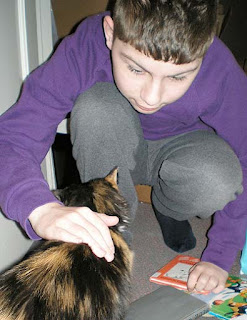
Inky's stay with us is winding down. Her owners tell me they will be back in town next week.

Inky's temperament has proven perfectly suited to our household: she makes her presence known, but has her own schedule and preferences. Princess that she is, she only deigns to allow us to care for her. She has her agenda and plans, and if her path happens to cross with ours, she might permit us to pet her or play with her.

After two months of warning the boys not to get too attached, I am the one who is overly devoted to Inky. (Perhaps I can negotiate visitation rights?)

Yesterday, at a sale, Hart discovered a toy calico cat, and rushed over to show me, crowing, “Inky, Inky, Inky.” We are complete pushovers for stuffed animals. I hesitated. But in that nano-second I realized that having a toy representation of Inky is bound to be difficult once she leaves. After Hobbes died, Jeff told me that the two snapshots of her on the fridge “made him sad,” so I removed them. A toy Inky is no equivalent for the real one.

“Let’s buy it for Inky’s parents!” I said to Hart. I had a brief notion of presenting it to them as a "welcome home" token. But again, good sense overcame impulse. I know that if we bring that toy into the house, we will never be able to relinquish it, no matter how well-meaning our intentions.

April 26, 2007

Amen, Sister!

After reading Stephanie Fosnight's column, I sent her an email response.

I have two, count 'em two, such children. Eating out is one pleasure I would not forgo when we adopted the twins over ten years ago. I have found that other diners do not care to be involved in a social experiment and prefer that families with autistic children just stay home . . . for the next twenty years.

The onus is on us parents to make the trip successful. My tips:

Go early, so that the restaurant is not too crowded and the waitstaff are not frazzled. But not too early, when there might be a single waiter for the whole place.

Never go anywhere that requires a wait for a table.

Avoid eateries that cater to families with children. The food is awful and there are lots of children whose behavior is not a good model for yours.

Avoid places that are so quiet you can hear glasses and silverware clink, but

Avoid loud restaurants, or ones with piped-in music. It's unpleasant and over-stimulating for autistic and hyperactive children; they can't tune it out.

Order ahead. Restaurants love quick turnover for their tables. Call your order in, sit down, eat and leave.

Request a booth, if possible, off the main traffic route. I have learned the hard way not to sit too close to senior citizens, in the main area, or near the entrance. I do not relish being entertainment for the entire restaurant!

Bring engaging activities: pad and crayons, music, small toys. Play "I Spy" while you wait.

Remind children about expected behavior. Our family's rules are: "inside voice only" and "stay in your seat." If I give more than one warning for each, we have to leave.

Let other adults at the table know to decide immediately what they want, so that they can order the first time the server approaches. If someone needs "another minute, please," they will be sorry and so will your child. Also, you may never see your waiter again.

Tip the staff well.

Eating Out With Autistic Children (article)

Skokie-Review.com Member of the Sun-Times News Group

April 26, 2007

Restaurant visits tough when kids have autism

Last Friday night, I went out for a late dinner with friends. The company was excellent; the food passable. But when I remarked that the meal seemed overpriced, a companion pointed out that we'd spent two and a half hours in a cheerful setting with great service.

"You're paying for a piece of temporary real estate when you go out to a restaurant," he said.

This comment got me thinking about just what kind of environment we expect when we go out to eat. Most of us, I'd wager, simply want a congenial place to chat and nosh on enjoyable food.
Yet for families of kids with disabilities, this is a simple pleasure often denied. Worse, these moms, dads and kids often get censured by other diners -- and sometimes even the staff -- if their children start to act up, as they so often do.

I recently sat in on a meeting of the Autism Task Force of the North Suburban Special Education District. This group of parents, mostly moms, works hard on autism issues in order to help other families like themselves.

These parents would also like to take their kids out for a meal once in awhile.

Gerry told me how she'd take her now-grown son out and hear comments like, "Look at that little brat." Mia explained how hard it is on her other children when her autistic son becomes unruly and the whole family suddenly has to leave.

"The other kids get so compromised by a child with a disability," she said.
Ann has been smarting over one incident for years. She and a friend had gone out to lunch, bringing both of their children. Then Ann's son, who's autistic, started getting fussy.

Ruined lunch?
When two other diners loudly told the manager their meal had been ruined by "that child," while glaring in Ann's direction, she started to feel pretty fussy herself.

Still, Ann and her friend tried to explain to the women that the boy had a disability, but the women merely ignored Ann and told her friend, "You have nothing to worry about. Your child behaved fine," before stalking out.

It was clear the irate ladies felt their lunchtime real estate had been pollluted by an undesirable neighbor.

The task force members know plenty of families who've just stopped going out to eat. It's too traumatic, they say. Yet staying home all of the time can be isolating. Besides, many autistic children need to learn basic social skills like eating in a restaurant, ordering from a menu and handling money. All of this takes practice.

Michelle Wolke has spent 35 years helping children with autism learn to eat out. The Northbrook resident, who runs a private therapy practice with her son Jason Portman, takes kids from all over the city and suburbs out on restaurant excursions.

Though Wolke herself is immune to embarrassment after all these years, she knows it can be annoying or even frightening to other diners when a child suddenly throws a tantrum, tries to run away, or starts shouting. One of her charges, in fact, has a habit of announcing, "All done!" before suddenly throwing whatever is in front of him across the restaurant.

Changing behavior
Wolke is, of course, working with the child on correcting this behavior, but she also warns other diners when she brings in her students.

"I tell them I'm here with an autistic kid and that he might throw something or kick," she said. She also asks to be seated in a back booth, brings activities for the children to play with while waiting, and asks the manager for quick service and patient wait staff.

The best restaurants, according to the parents I spoke to, are understanding and accomodating. They prepare meals according to an autistic child's special request, move them to the front of lines, and understand if the family needs to make a quick exit.

But what about the rest of us?
If you see a child throwing a tantrum or being especially fussy, ask the parent if and how you can help. Don't judge if you see a kid watching a portable DVD player while the rest of the family eats, or if a mom lets her boy sing to himself as she finishes her meal.

Whether you're at McDonalds or at Charlie Trotter's, be patient and remember that these kids may be unruly but they're still kids. Just like any other kids, they deserve to go out and order a meal.

The rate of children born with autism has risen from 1 in 166 to 1 in 150 in just two years, according to the Autism Society of America. More and more parents are bearing the immensely heartbreaking, high-stress burden of trying to raise an autistic child as normally as possible.

The least we can do is welcome them onto the grounds of our temporary patch of real estate.

Stephanie Fosnight may be reached at sfosnight@pioneerlocal.com.

My orthodonist would be proud! (photo)

Suzanne, Lisa and Meiya

April 24, 2007

Llama (art)

Llama, Jeff, from ANIMALS OF THE WORLD

April 16, 2007

Cats are fickle creatures (photos)

"I love you, I love you, I love you."

"Talk to the tail."